
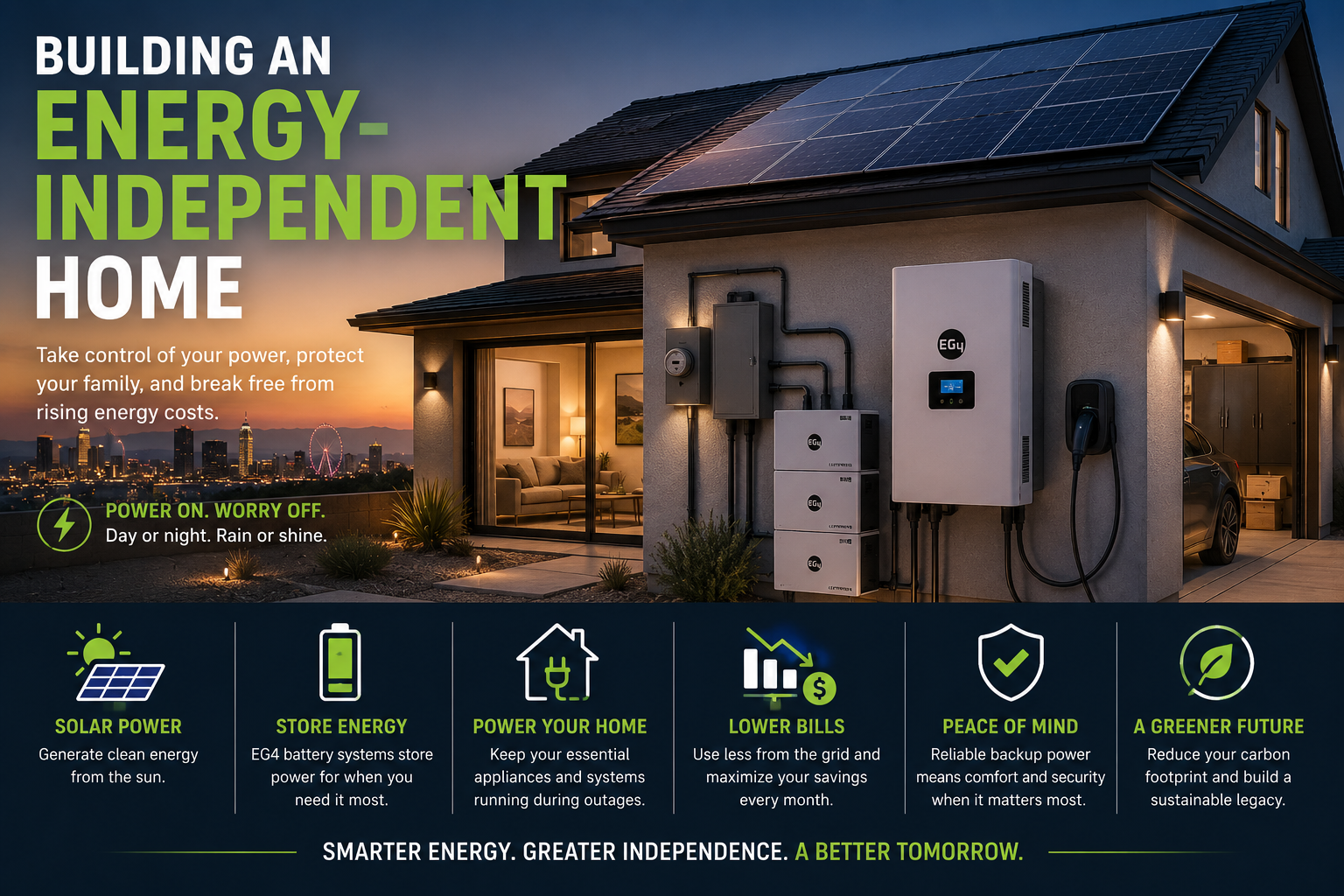
Building an
Energy-Independent Home
The Future of Home Energy Begins Today
For generations, powering a home was relatively simple.
Electricity came from the utility. Your electrical panel distributed it. Your appliances consumed it. At the end of the month, you received a bill telling you how much energy you used.
Today, that relationship is changing.
Homes can now generate electricity with solar panels, store energy in battery backup systems, monitor individual electrical loads, intelligently manage circuits, charge electric vehicles, and even use solar energy to help heat and cool individual spaces.
The modern home is no longer limited to simply consuming electricity.
It can become an active participant in managing its own energy.
Welcome to the idea of the energy-independent home.
Energy Independence Doesn’t Necessarily Mean Going Off-Grid
When people hear “energy independence,” they often imagine disconnecting completely from the electrical grid. That isn’t necessarily the goal.
For many homeowners, energy independence means having more choices about where their electricity comes from, when they use it, and which electrical loads receive priority. The utility grid can remain an important energy source. But instead of being the home’s only source of electricity, it can become one part of a larger home energy management system.
Solar can provide energy when the sun is shining. A home battery backup system can store energy for later. A smart electrical panel can provide visibility and control over electrical loads. An EV charger can intelligently manage one of the home’s largest new electrical demands.
And high-efficiency equipment such as heat pumps and hybrid solar mini-splits can help reduce the amount of energy required to keep the home comfortable.
Each technology provides a benefit on its own.
The bigger opportunity comes when they begin working together.
Step One: Understand Where Your Energy Goes
Before producing more electricity, it helps to understand how the electricity you already have is being used.
Air conditioning, pool equipment, electric water heating, kitchen appliances, EV charging, lighting, and countless smaller loads all contribute to a home’s overall energy consumption.
But not every load operates at the same time or carries the same importance.
This is where home energy monitoring becomes valuable.
Modern energy-monitoring equipment and smart electrical panels, such as the SPAN Smart Panel, can provide homeowners with greater insight into circuit-level energy use.
Instead of seeing only one number on a utility bill, you can begin asking better questions:
Which equipment consumes the most electricity?
When does my home experience its highest electrical demand?
What could I turn off or manage differently?
Which circuits would I actually need during an outage?
Understanding those answers is one of the first steps toward smart home energy management.
Because before you can intelligently control energy, you need to understand it.
Step Two: Generate Some of Your Own Energy
Once you understand consumption, the next piece of the puzzle is generation.
For many homes, that means solar energy. Solar panels convert sunlight into electricity that can help offset energy normally purchased from the utility.
In a place like Southern Nevada, the relationship is especially interesting: some of the brightest, hottest days can also be the days when homes demand significant amounts of electricity for cooling.
Solar provides an opportunity to produce energy during many of those daylight hours. But there is an important limitation. Solar production and household consumption don’t always happen at exactly the same time.
That leads us to the next piece of the energy-independent home.
Step Three: Store Energy for Later
Imagine producing electricity during the afternoon but needing that energy after sunset.
That’s where battery energy storage changes the equation.
A residential battery storage system can store electrical energy and make that energy available when the home needs it.
Depending on the system design, battery storage can serve several purposes: supporting critical loads during a power outage, storing available solar energy, reducing dependence on grid power during certain periods, and providing homeowners with greater flexibility over how their energy is used.
Modern systems from manufacturers such as LG Energy Solution and EG4 are helping make residential energy storage an increasingly important part of the modern electrical system.
But there’s something homeowners should understand:
A bigger battery isn’t automatically a better battery system.
Battery capacity is measured in kilowatt-hours (kWh). How long that stored energy lasts depends largely on what you’re asking the battery to power.
Backing up refrigerators, lighting, internet equipment, security systems, and selected receptacles is very different from trying to operate every major appliance in the home simultaneously.
That’s why a good battery backup system design starts with understanding the loads.
Step Four: Decide What Really Needs Power
Here’s where energy independence gets interesting.
During an outage, does everything in your home really need to operate?
Maybe not.
You may care much more about keeping the refrigerator cold, internet operating, security system online, a few lights available, and selected heating or cooling equipment running.
This concept is known as critical load management.
Rather than designing battery storage around the assumption that every electrical load is equally important, homeowners can prioritize the circuits that matter most.
Modern smart panels and energy management systems can take this concept even further by providing greater control over which loads receive available energy.
Think of it this way:
Solar produces the energy.
Battery storage saves the energy.
Smart energy management decides where the energy matters most.
That combination can dramatically change how we think about backup power.
Step Five: Make the Home More Efficient
There’s another side to energy independence that doesn’t get enough attention.
Sometimes the smartest kilowatt-hour is the one you never needed to use.
Energy efficiency can reduce the amount of generation and battery storage required to accomplish the same goal.
That might mean installing LED smart lighting, improving insulation, upgrading inefficient equipment, using high-efficiency heat pumps, installing a hybrid solar mini-split, or intelligently controlling larger electrical loads.
This matters because every reduction in unnecessary energy consumption allows your available solar and battery capacity to go further.
Energy independence isn’t only about producing more power.
It’s also about needing less power to accomplish the same thing.
Step Six: Prepare for the Electric Home
Our homes are becoming increasingly electric.
Electric vehicles are replacing gasoline-powered transportation for some households. Heat pumps are replacing traditional heating equipment. Smart appliances are becoming more common. Battery storage is expanding. Solar continues to evolve.
That means the home’s electrical infrastructure matters more than ever.
An EV charger installation, for example, can introduce a significant new load. Add electric HVAC equipment, battery storage, solar, and other technologies, and suddenly the electrical panel isn’t merely something hidden in the garage.
It becomes infrastructure for the home’s future.
This is why electrical panel upgrades, smart electrical panels, load management, EV charging, solar integration, and battery backup systems should increasingly be considered together rather than as completely separate projects.
What Could the Energy-Independent Home Look Like?
Imagine coming home in the afternoon.
Solar panels have been producing electricity throughout the day.
Some of that energy helped operate your solar mini-split air conditioner.
Some charged your home battery storage system.
Your smart electrical panel monitored energy consumption throughout the house.
Your EV is connected to its charger.
Then the utility experiences an outage.
Instead of the entire home immediately going dark, the energy system responds according to how it was designed. Battery storage becomes available for designated loads, while energy management helps prioritize the circuits that matter most.
The refrigerator stays cold.
Selected lighting remains available.
Internet and communications continue operating.
Important equipment stays powered.
That is when solar, battery backup, smart panels, energy monitoring, and load management stop feeling like separate pieces of technology.
They begin functioning as an energy system.
You Don’t Have to Build It All at Once
Perhaps the best part is that an energy-independent home doesn’t necessarily have to be created in one massive project.
It can begin with an EV charger.
Or a hybrid solar mini-split.
Or home energy monitoring.
Or a smart electrical panel.
Or a properly designed battery backup system.
The important part is thinking ahead.
When each improvement is planned with the home’s future energy goals in mind, today’s electrical upgrade can become part of tomorrow’s larger smart energy solution.
At HD Electric, we believe the future of electrical work isn’t simply about delivering electricity to equipment.
It’s about helping homeowners understand, generate, store, manage, and intelligently use energy.
For homeowners exploring solar energy, battery backup installation, smart electrical panels, EV charger installation, energy-efficient heating and cooling, and smart home energy solutions in Las Vegas, the journey toward greater energy independence can begin one practical upgrade at a time.
The energy-independent home isn’t some distant concept waiting for the future.
The technology is already here. The question is how intelligently we choose to put it together.
Ready to Power Up
Your Property?
