
Comfort Powered by the Sun
A Smarter Way to Heat and Cool Your Home
In Las Vegas, sunshine is something we have in abundance. Unfortunately, so is the need for air conditioning.
During the hottest months of the year, cooling can become one of the largest electrical loads in a home. That creates an interesting question: What if the same Nevada sunshine driving up your cooling demand could also help power the air conditioner keeping you comfortable?
That is exactly where a hybrid solar mini-split heat pump system becomes interesting.
Rather than thinking of solar only as a large rooftop system designed to offset an entire home’s electricity consumption, homeowners can use dedicated solar panels to help power one of the appliances that needs energy the most—a mini-split air conditioner and heat pump.
How Does a Solar Mini-Split Work?
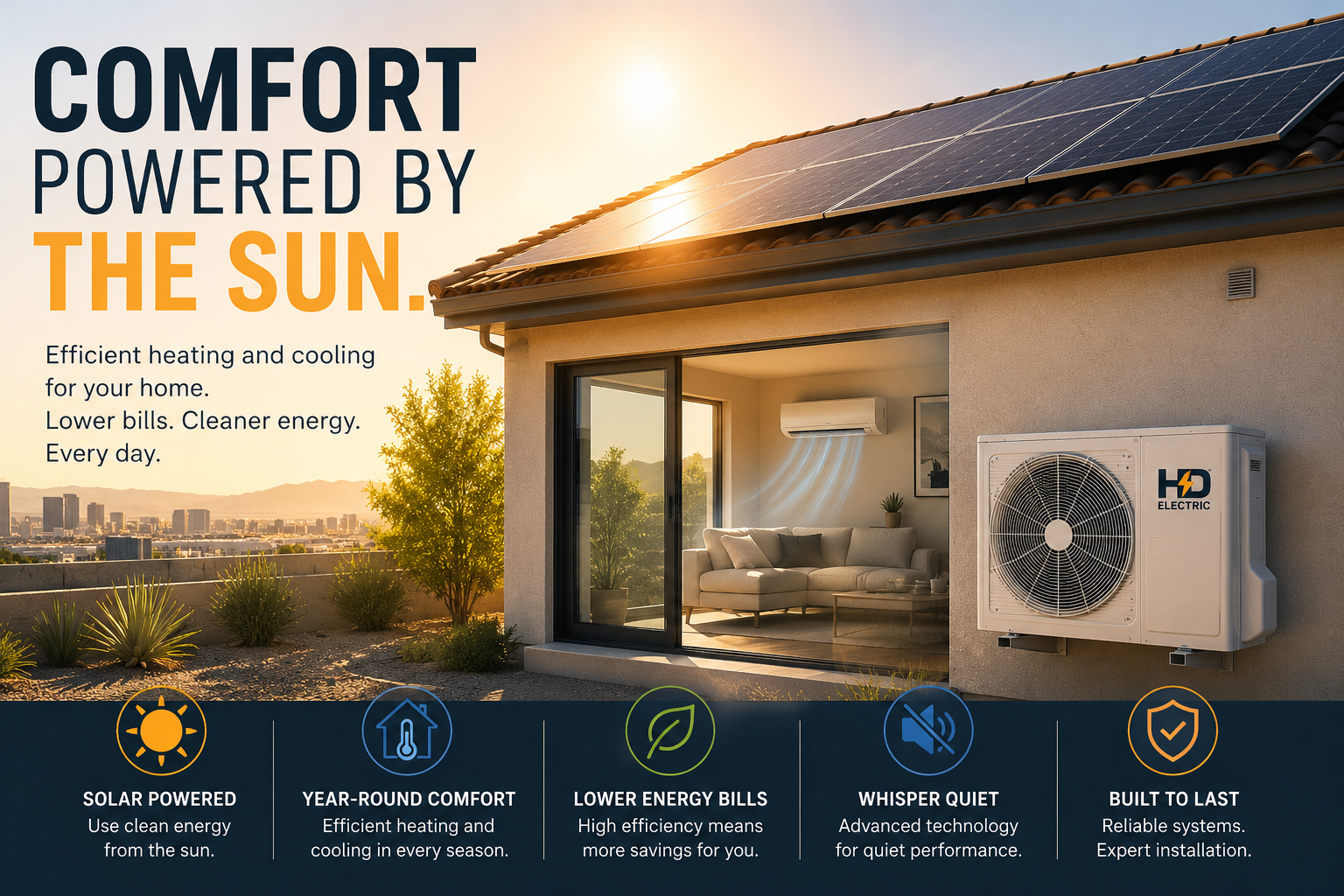
A hybrid solar mini-split combines high-efficiency heating and cooling technology with direct solar power.
During daylight hours, dedicated solar panels generate DC electricity and deliver it to a compatible solar-powered air conditioner. Depending on the equipment and operating conditions, the system can use available solar energy while supplementing it with utility power when necessary.
That’s the “hybrid” part.
Instead of asking the sun to do everything or relying entirely on the electrical grid, the system can take advantage of both energy sources.
When sufficient sunlight is available, solar energy can contribute significantly to operating the mini-split. As solar production decreases—such as during clouds, evenings, or periods of higher demand—the system can transition to or supplement operation with grid power.
The homeowner doesn’t have to constantly decide which source to use. The equipment manages the energy automatically.
Why Pair Solar With a Heat Pump?
There is another important piece of the technology hidden inside the name: heat pump.
A heat pump doesn’t create heating and cooling the same way traditional resistance heating equipment does. Instead, it moves heat from one location to another.
During summer, it removes heat from inside the home and transfers it outdoors.
During colder weather, the process can reverse, allowing the system to provide heating.
That means one energy-efficient mini-split system can provide both heating and cooling without requiring traditional ductwork.
For homeowners interested in energy-efficient heating and cooling, this can make a hybrid solar mini-split particularly useful for garages, workshops, additions, converted rooms, guest houses, offices, and areas where extending an existing HVAC system may be difficult or expensive.
What Equipment Does a Solar Mini-Split Need?
A typical solar mini-split installation begins with a few important components:
Solar panels capture sunlight and convert it into DC electricity.
The hybrid solar mini-split outdoor unit contains the compressor and electronics necessary to operate the heating and cooling system and manage the available energy sources.
The indoor air handler delivers conditioned air directly into the room or space.
The refrigerant lines, electrical conductors, disconnecting means, mounting equipment, and control wiring connect the system and allow it to operate safely.
Depending on the equipment selected, the solar array may connect directly to the solar HVAC equipment rather than first passing through a conventional whole-home solar inverter. This is one reason equipment compatibility, PV voltage, conductor sizing, disconnect requirements, and manufacturer specifications need to be evaluated during system design.
Solar-powered air conditioning isn’t simply a matter of connecting a few solar panels to a conventional mini-split.The equipment must be designed to work together.
How Many Solar Panels Does It Take
This is one of the first questions homeowners ask, and the answer depends on the specific system.
The required solar array can vary according to the mini-split’s capacity, solar-panel wattage, panel operating voltage, available sunlight, equipment specifications, and the manufacturer’s allowable PV input range.
That means designing a solar mini-split system should begin with the equipment—not an arbitrary number of panels.
A properly designed system considers:
What are the mini-split’s solar input requirements?
What are the voltage and current characteristics of the selected solar panels?
How will those panels behave when connected together?
Does the resulting solar array remain within the equipment manufacturer’s minimum and maximum PV operating limits?
And perhaps most importantly:
How much heating and cooling does the space actually need?
Installing a larger system isn’t automatically better. Proper sizing matters for comfort, efficiency, equipment performance, and energy consumption.
What Happens When the Sun Goes Down?
This is where the word hybrid becomes especially important.
A hybrid solar air conditioner can use solar energy when it is available while maintaining access to utility power. When solar production falls later in the day, the system can continue operating from the grid rather than simply shutting down with the sunset.
But there is an important distinction:
Solar capability does not automatically mean backup power.
If the utility grid experiences an outage, whether a particular system continues operating depends on how that system was designed and what equipment is installed.
For homeowners who want heating and cooling to remain available during an outage, a battery backup system can become another part of the conversation.
Solar generates energy.
A battery can store energy.
A hybrid mini-split uses energy to keep the home comfortable.
Combine those technologies thoughtfully, and you begin moving beyond individual products toward a home energy management system.
Is a Hybrid Solar Mini-Split Right for Every Home?
Not necessarily—and that’s why an assessment matters.
Available roof or ground space, solar exposure, shading, electrical infrastructure, room size, insulation, equipment location, heating and cooling requirements, and the homeowner’s energy goals all influence system design.
For one homeowner, the goal might simply be reducing the daytime electrical demand of an frequently used room.
For another, it might be conditioning a garage without extending the home’s existing ductwork.
Someone else may be building toward solar energy, battery storage, smart electrical panels, EV charging, and greater energy independence.
The technology should serve the goal—not the other way around.
Turning Nevada Sunshine Into Comfort
Las Vegas receives something incredibly valuable almost every day: sunlight.
A hybrid solar mini-split heat pump provides an opportunity to put some of that energy to work exactly when cooling demand can be at its highest.
And perhaps that is the most interesting part of solar air conditioning.
The sun doesn’t have to power everything in your home for solar energy to make a meaningful difference. Sometimes the smarter approach is identifying where your home uses energy and finding practical ways to reduce that demand one system at a time.
At HD Electric, we help homeowners explore solar mini-split installation in Las Vegas, electrical integration, solar energy, battery backup, and smart energy solutions as pieces of a larger energy strategy.
Because a smarter energy-efficient home isn’t necessarily built all at once.
Sometimes, it starts with one room—and a little Nevada sunshine.
Ready to Power Up
Your Property?
